I have just returned from a month-long set of back-to-back tours in Brazil’s enchanting and wild Pantanal region.
It’s one of my all-time favorite destinations, mostly because I have a certain confidence that my guests are likely to have their expectations, not only realized, but exceeded by a pretty large margin.
Nothing, of course, in nature is guaranteed. But the Pantanal is such a biodiverse region, with so many different species to see, that one merely needs to look in any given direction, and chances are, there will be an animal (or animals) in your line of sight.
There are over 600 species of birds in the Pantanal, and although my tours are not focused on the avifauna of the region, we still managed to clock something like 220 species over the course of two tours.
But it’s not just the diversity that excites me. It’s the fact that there are just so many birds, and in such great abundance, that unless you suffer from Ornithophobia (the fear of birds) you are going to have your socks blows off by the sheer densities of feathered creatures.
There are giant rheas (South America’s version of the ostrich) and there are long legged Jabiru storks (many of which are attending chicks in their massive nests, at this time of year)
They strut around the margins of uncountable waterholes, along with hundreds of herons, egrets, spoonbills, kingfishers, anhingas, and waterfowl.
It must be quite stressful to be a fish in the Pantanal, as it seems everything is out to eat them.
Other avian treats are also an everyday occurrence, and range in size and scope from pretty little flycatchers and cardinals, to the pheasant-like curassows and Guans.
The stars of the show though are the hyacinth macaws; beautiful blue/purple parrots, many of whom also have chicks at this time of year.
We had plenty of opportunities to photograph them.
[/vc_column_text][/vc_column][/vc_row]


One animal that isn’t interested in fish, however, is the giant anteater. These outlandish creatures, with their elongated noses, and huge shaggy tails, like to patrol the Pantanal’s grassy plains in search of termites to terrorize.
They are predominantly nocturnal by nature, and so it is customary for me to take my groups out in an open Safari vehicle at sunset and before sunrise in an attempt to find them sauntering between tombstone-like termite hills. But this year was a little different.
Instead of being out in the cooler, darker hours, we instead found no less than five different giant ant eaters who were out and about in the late afternoon.
It was a rare treat to see so many of them (they are usual scarce and by no means a guarantee on my trips)
And it wasn’t only the anteaters who had decided to grace us with their presence during daylight hours. The typically shy and rarely seen tapir was also a familiar friend this year.
We saw, and photographed 5 of these bizarre ungulates; some in the water (which is where they like to hang out) whilst others were strolling through open pastures and fields.
…And if you don’t know what a tapir looks like…Well, imagine a donkey mixed with an elephant with a short trunk. They are one of my very favorite animals, and it was such a treat to see so many of them this year.
We also saw and photographed the diminutive tamandua anteater, three species of deer, armadillos, howler and capuchin monkeys, coatis, crab eating foxes, and even an ocelot or two (a mid-sized spot-patterned wild cat, as beautiful as any cat could be)
…And of course, there are loads and loads of capybaras all over the place: - a rodent that closely resembles a guineapig- should that guineapig be the size of a rottweiler.
The highlight for me, and for many of my guests too, were the many encounters we had with Giant River otters. These voracious fishers are always a treat to watch, because they are always very active, catching fish, playing with their cubs, or getting into very loud arguments with Jaguars.


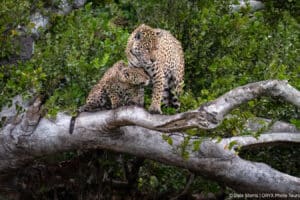
And that leads me into the main reason why almost any photographer comes to the Pantanal… The legendary Jaguar. South America’s apex predator.
“How likely do you think it will be that we will see a Jaguar?” one of my guests asked me at the start of our tour “I would so love to see and photograph one”
I smiled at the question.
“I’m pretty confident you will” I replied.
I’ve been coming to the Pantanal twice a year for over a decade now, and each time I come here, I see more and more jaguars patrolling the river banks in search of their favorite prey (the crocodilian Caiman) And yes, they do sometimes eat giant river otters.
On my first year, I saw 4 Jaguars. But each year, more and more of these powerful and beautiful predators become ever more accustomed to the sight and sounds of tourist boats.
They don’t hide. They are not shy. And they go about their business as if we were not there observing them from the safety of our boats.
And although I am always confident that my guests will not only see, but be able to photograph numerous Jaguars on each trip, this year was an exceptional one.
Get this! Over the course of ten days of exploring the Pantanal River systems by speed boat, we had no fewer than 55 Jaguar sightings, amounting to what we believe to be more than 20 different individual cats.
Epic doesn’t even come close to describing what it’s like to get up in the morning, to head out on our speed boat under the orange skies of a pre-dawn day, and see jaguar, after jaguar, after jaguar.
So, please come join me next year in Brazil’s wonderful Pantanal, and let’s see if we can beat that record. I kind of think we can.


For information on my scheduled photo tour departures, please email info@oryxphoto.com
For information on my private photo tour departures, please email private@oryxphoto.com